
How to read an Irish hallmark
Four stamps, usually smaller than a grain of rice, tell you what the metal is, where it was tested, roughly when, and who made it.
Somebody hands me a silver bowl and asks whether it is Irish. The answer is stamped into it, usually somewhere awkward, usually worn, and usually no bigger than a grain of rice.
Four small marks, and between them they tell you what the metal is, where it was tested, roughly when, and who made it. Once you know what you are looking at, you can read most of it yourself.
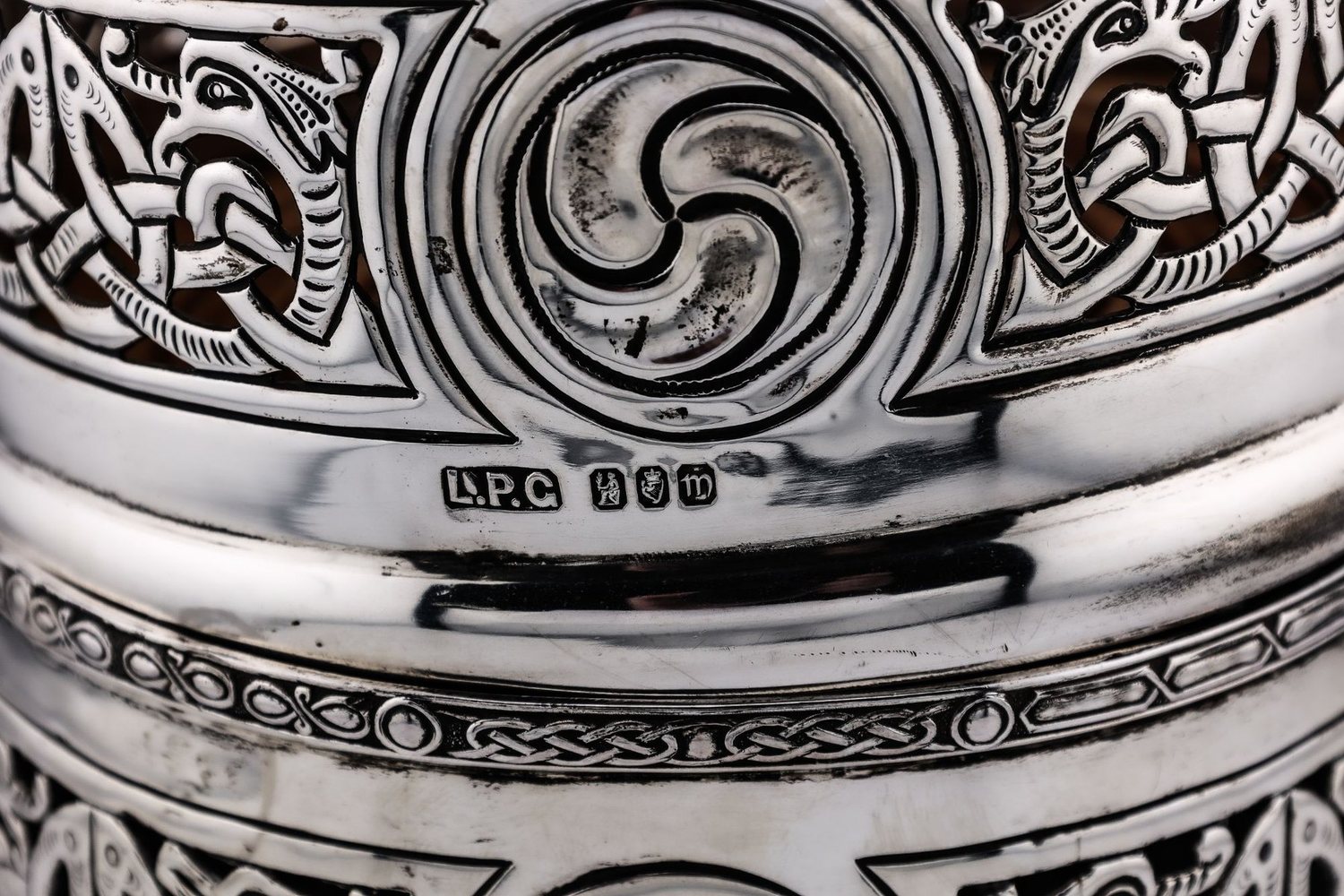
The four marks
The maker's mark. Initials in a shield, struck by whoever made the piece. This is the one that identifies the silversmith, and it is the one that turns an anonymous bowl into a named piece, which can change the value considerably.
The crowned harp. This is the fineness mark, and it is the important one. It says the metal has been tested and meets the sterling standard, 925 parts of silver in every thousand. It was also used on 22 carat gold. It is not a town mark, it is a guarantee of quality, and it does the same job as the lion passant on English silver.
Hibernia. A seated female figure, the personification of Ireland. She was introduced on 25 March 1730 as a duty mark, to show that tax had been paid, and she has since become the signature of the Dublin Assay Office. If Hibernia is there, you are almost certainly holding Irish silver.
The date letter. A single letter telling you the year the piece was assayed. The system began in 1638 and the letter changes every January.
Four stamps the size of a match head, and they carry more reliable information than any certificate, because they were struck before the piece ever left the workshop.
Where to look
It depends on the object, and whoever struck them was thinking about the assay office, not about you.
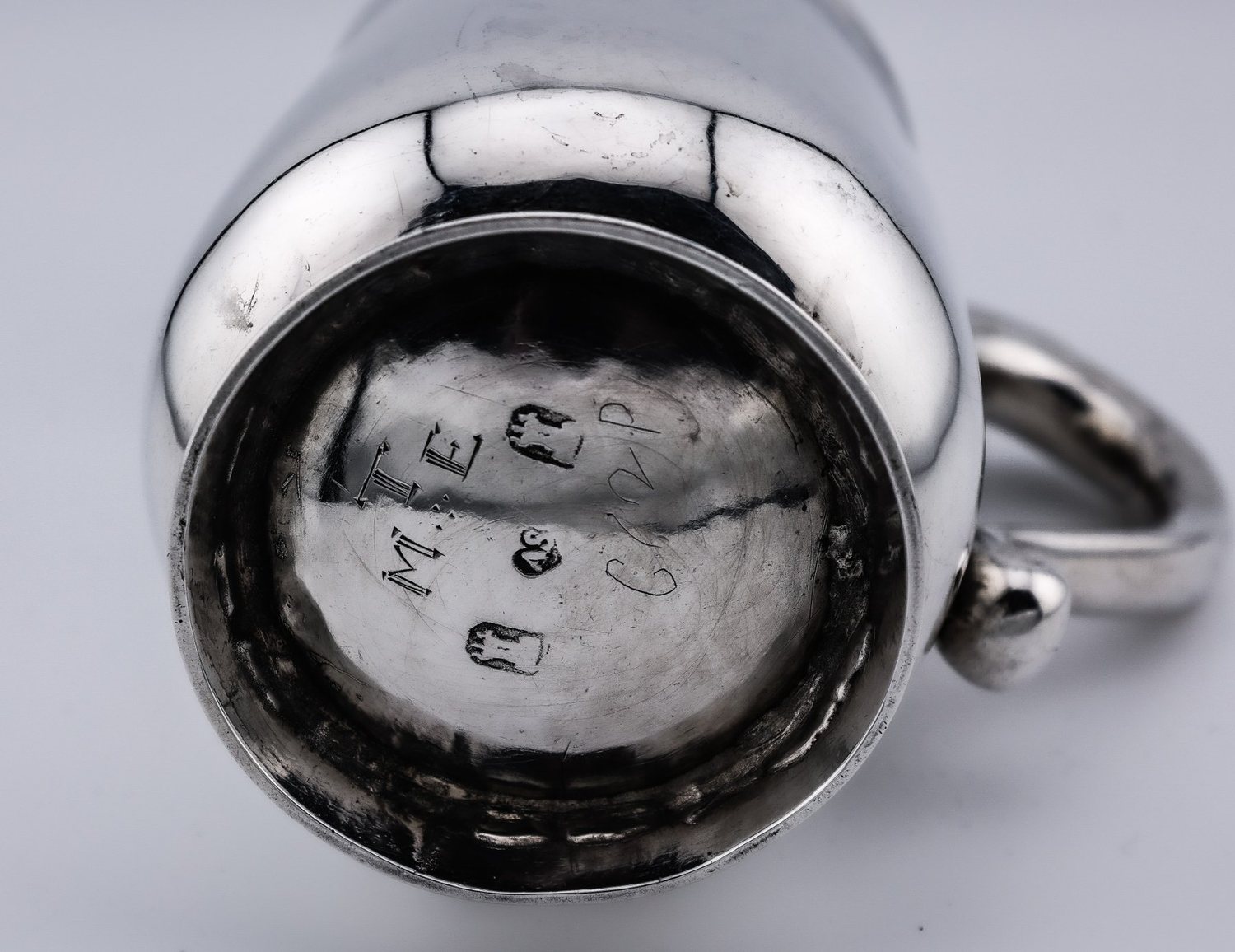
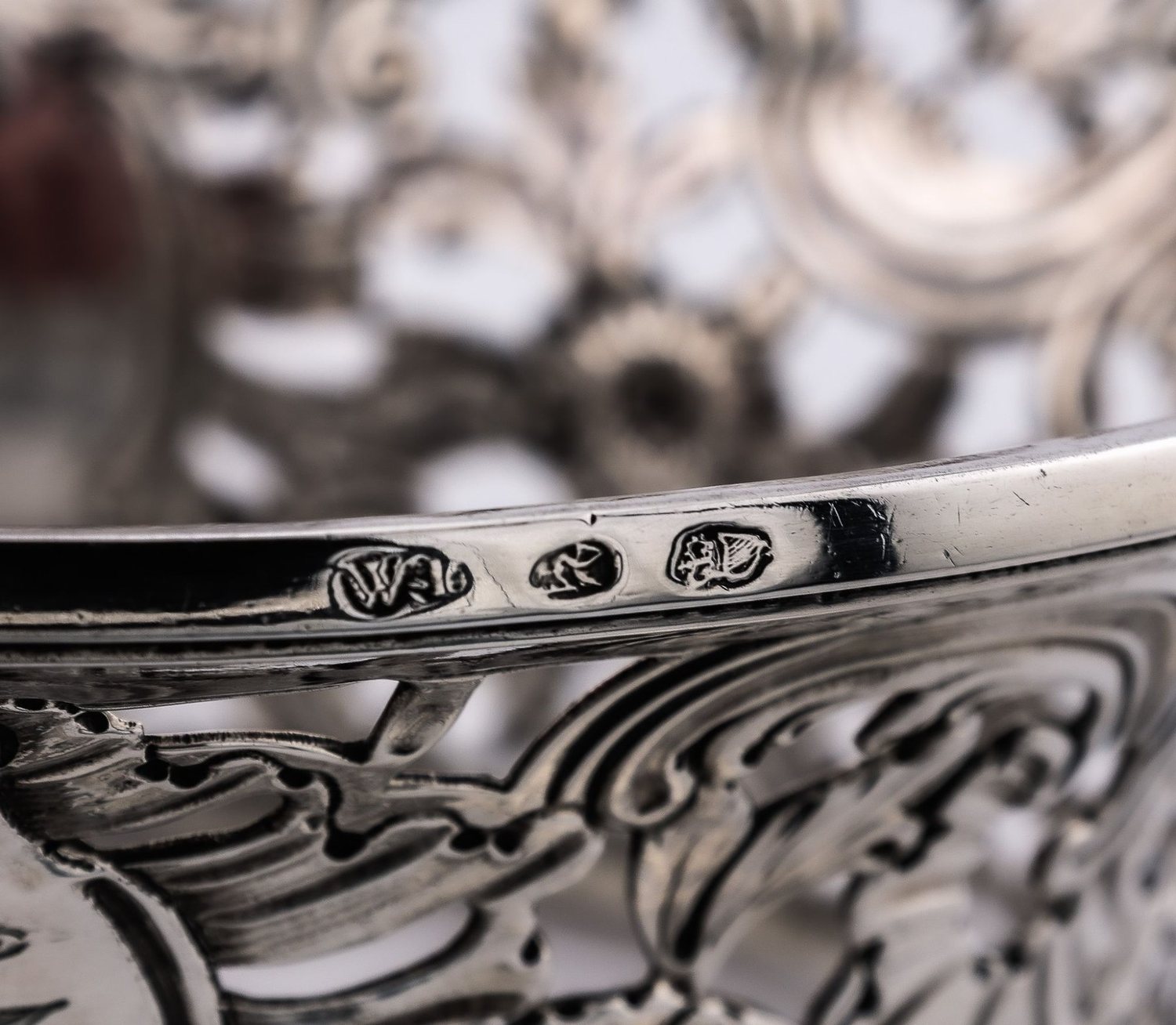
On a bowl or a cup, look at the underside near the foot, or in a line on the side below the rim. On a rim or a border, marks are often struck into the curve, which is precisely where they wear. On flatware, look on the back of the handle. On a teapot, look at the base and on the lid, because those were marked separately.
Dating it, carefully
The date letter is the part people get wrong, and it is worth understanding why.
The alphabet runs in cycles, so the same letter comes round again and again over the centuries. What separates one cycle from the next is the shape of the letter, whether it is upper or lower case, and the shape of the shield around it. An 1820 letter and a 1900 letter can be the same letter of the alphabet.
So a date letter is read against a table, matching the exact letterform and shield, and cross checked against the other marks and against the style of the object itself. A piece that looks 1780 and reads 1900 is telling you something, and usually what it is telling you is that the marks have been let in from another object.
After 2002
Irish hallmarking law changed on 1 October 2002. Fineness marks became numerals, so the crowned harp stopped being the fineness mark for sterling and was replaced by 925 in an oval. Modern pieces carry numbers rather than symbols, so you will see 925 for silver, or 375, 585 and 750 for 9, 14 and 18 carat gold. The date letter became optional at the same time, which is why a recent piece may not carry one.
Hibernia is still struck. She has outlasted the duty she was introduced to record, the Act of Union, and independence.
One thing that destroys value, quietly
Over-polishing.
Every polish takes a little metal away, and the marks are shallow to begin with. Decades of enthusiastic cleaning can soften them to the point where the date letter is unreadable and the maker's mark is a blur.
A piece with crisp marks and a bit of tarnish is worth more than the same piece polished to a mirror with the marks worn flat. If you are minding old silver, clean it gently and stay away from the hallmarks.
When it is worth asking
If Hibernia is there and the maker's mark is legible, it is worth having looked at properly, because Irish silver carries a premium and a named Dublin maker can carry a considerable one.
Bring the piece, or send a clear photograph of the marks taken straight on with good light. Half the job is being able to see them at all.
Sources
Dates and marks per the Dublin Assay Office, established at Dublin Castle in 1637. Date letters from 1638, Hibernia from 25 March 1730.
The changes of 1 October 2002, including numerical fineness marks and the date letter becoming optional, per the Assay Office's own legislation page. Photographs my own.
Read next
What lab grown diamonds did to the value of your ring
Colin Weldon · GIA Graduate Gemologist · Dublin